
AI Local Search
How AI Is Changing Local Search for Small Businesses
Customers now ask AI, compare in Maps and read review summaries before they call. What that shift means for small businesses and how to stay easy to find.
Last updated Written by Darren Walker, founder

Local search used to follow a fairly predictable path.
Someone needed a plumber, dentist, accountant, restaurant, or contractor. They searched Google, looked at the map results, checked a few reviews, visited a website, and made a call.
That journey still happens.
But it is no longer the only journey.
Customers can now ask ChatGPT for a recommendation, use Google AI Mode to compare options, ask Google Maps a conversational question, read an AI-generated summary of reviews, and move between several platforms before deciding which business deserves their attention.
For local businesses, this does not mean traditional Local SEO is disappearing.
It means local discovery is expanding.
The businesses that succeed will need to be easy for both people and machines to understand, verify, and recommend.
Local Search Is Becoming a Conversation
Traditional local searches are usually short:
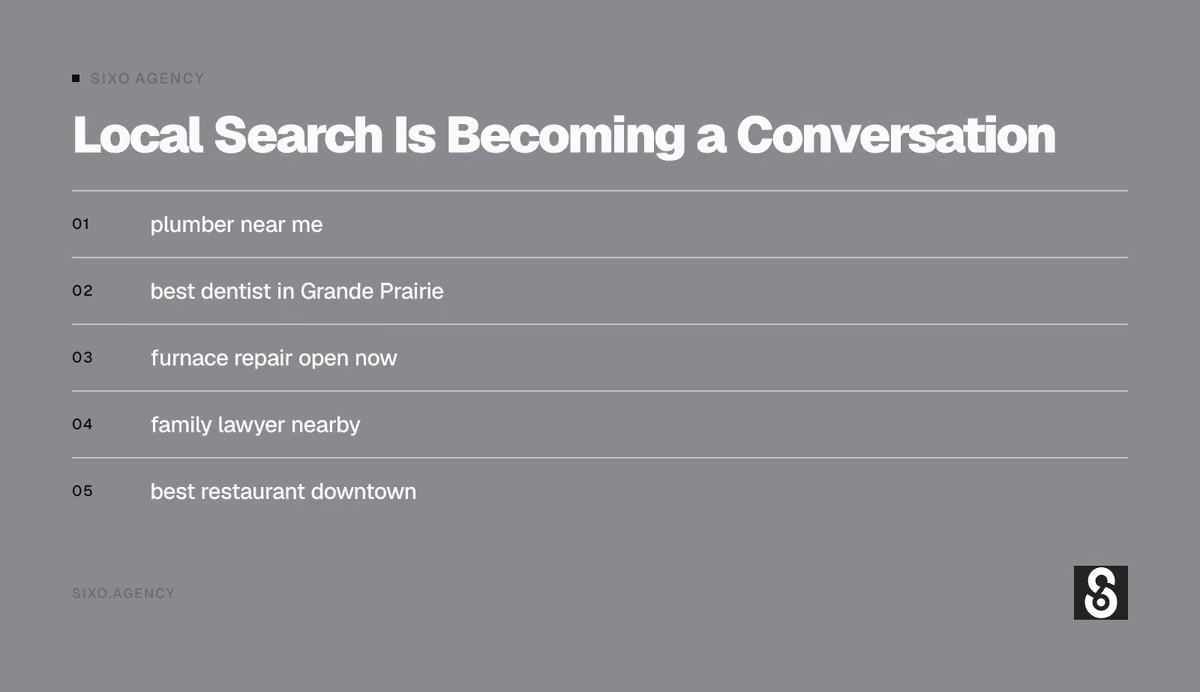
- plumber near me
- best dentist in Grande Prairie
- furnace repair open now
- family lawyer nearby
- best restaurant downtown
AI allows people to be much more specific.
Instead of searching for:
plumber near me
someone can ask:
Who is a well-reviewed plumber near me that handles emergency calls, works evenings, and has experience with older homes?
That is a very different search.
The customer is not simply asking for a list of nearby businesses.
They are describing a situation and asking the system to narrow the choices.
Google is building this behaviour directly into its products. Google introduced Ask Maps as a conversational way to ask more complex questions about places and receive recommendations based on information available through Maps.
Google’s AI search experiences work on a similar principle. A complicated question can be broken into multiple related searches and signals before an answer or recommendation is assembled.
For a local business, that means being relevant to the initial keyword is no longer the whole problem.
The system may also be trying to understand:
- what services you provide;
- where you provide them;
- when you are available;
- what customers say about you;
- what makes you different;
- whether your website supports those claims;
- and whether other sources confirm the same information.
Local SEO is moving from matching a query toward understanding a business.
People Are Already Using AI to Find Local Businesses
AI-assisted local discovery is not just a future prediction.
Consumers are already using AI tools when researching businesses, comparing options, and deciding where to spend their money.
That does not mean Google Maps or traditional search has suddenly become irrelevant.
Instead, another discovery layer has been added.
A customer might now begin with ChatGPT or another AI assistant, receive several recommendations, and then move to Google to verify those businesses.
Or they might start in Maps, read reviews, visit a website, and use AI later to compare their options.
This creates an important distinction:
Google Maps visibility and AI visibility are related, but they are not necessarily the same thing.
A business can perform strongly in one environment while being poorly represented in another.
That means the next stage of Local SEO needs to think beyond a single ranking number.
Google Maps Is Becoming More Than a Map
Google Maps has traditionally been one of the most important surfaces in Local SEO.
A customer searches.
Google shows nearby businesses.
The customer compares:
- ratings;
- reviews;
- distance;
- hours;
- photos;
- services;
- and directions.
AI adds another layer.
Conversational search allows people to describe what they actually need rather than reducing everything to two or three keywords.
The difference is subtle but important.
A traditional Maps search might be:
Italian restaurant near me
A conversational search could be:
Where can I take six people for Italian tonight that’s quiet enough to talk, takes reservations, and has good vegetarian options?
The second query contains several attributes.
A restaurant needs to be understood not merely as an Italian restaurant, but as a business associated with:
- group dining;
- reservations;
- atmosphere;
- vegetarian options;
- availability;
- location;
- and positive customer experiences.
This is one reason richer, accurate business information is becoming increasingly valuable.
Your Google Business Profile Still Matters
With all the discussion surrounding AI search, it can be tempting to think Google Business Profile optimization is becoming outdated.
The opposite is closer to the truth.
Your Business Profile gives Google structured information about things such as:
- business name;
- location;
- contact information;
- business category;
- hours;
- photos;
- services;
- and other business attributes.
Those details help Google understand what your business is, where it operates, and when it may be relevant to a search.
AI doesn’t make Business Profile optimization less relevant.
It gives accurate business information another environment in which it can potentially be interpreted and used.
The practical lesson is simple:
Your Google Business Profile should accurately describe the same business your website describes.
Reviews Are Becoming Data, Not Just Testimonials
Reviews have always influenced customers.

A business with hundreds of recent, detailed reviews usually creates a different impression than one with twelve reviews from three years ago.
AI adds another dimension.
Instead of requiring a customer to manually read twenty individual reviews, software can summarize recurring patterns across them.
That means reviews can help answer questions such as:
- Do customers frequently mention fast service?
- Does this company handle emergencies?
- Are staff repeatedly described as professional?
- Do customers mention a particular service?
- Are there repeated complaints?
- Do people describe the business as expensive?
- Are there recent experiences supporting older ratings?
This changes the role of reputation management.
A five-star average remains useful.
But the substance, recency, and consistency of customer feedback become increasingly important when software can identify patterns across large numbers of reviews.
The answer is not to tell customers what they should write.
It is to create genuine customer experiences worth talking about, make leaving honest feedback easy, and respond appropriately when customers do.
Your Website May Matter More Than You Think
There has been plenty of speculation that AI answers will make websites less important.
For local businesses, that is a dangerous assumption.
Your website remains one of the few digital properties where you completely control the information describing your business.
It can establish:
- services;
- locations;
- expertise;
- staff;
- operating areas;
- project examples;
- answers to customer questions;
- pricing context;
- business history;
- contact information;
- and the relationship between different services and locations.
Search engines still need accessible, useful information.
Your website is one of the strongest places to provide it.
That does not mean publishing hundreds of pages of AI-generated text.
It means making your website the best first-party source available about your business.
AI Search Is an Entity Problem
One useful way to think about the change is to stop viewing your website as a collection of keywords.
Think about your business as an entity.
A search engine or AI system needs to establish basic facts.
Who are you?
What do you do?
Where do you do it?
Who do you serve?
What evidence supports those claims?
What do customers say about you?
Ideally, those answers should remain coherent across:
- your website;
- Google Business Profile;
- prominent directories;
- industry-specific listings;
- social profiles;
- structured data;
- reviews;
- local mentions;
- and other trustworthy sources.
This does not mean every description of your business needs identical wording.
It means the underlying facts should agree.
For example, imagine your website says you primarily serve Grande Prairie, but other profiles suggest Edmonton.
Your service pages focus on residential work, while your Business Profile appears to describe a commercial contractor.
Your opening hours vary across several prominent platforms.
Each individual inconsistency may seem small.
Together, they create ambiguity about the entity.
AI-assisted search makes that ambiguity increasingly difficult to ignore.
AI Visibility Is Not a Replacement for Local SEO
The terminology surrounding AI search can make this subject more complicated than necessary.

You may encounter terms such as:
- GEO;
- generative engine optimization;
- answer engine optimization;
- AI SEO;
- LLM optimization;
- AI visibility.
Some of those terms are useful for describing different search experiences.
But for a local business, the practical question is not:
Should we stop doing Local SEO and start doing AI SEO?
A better question is:
What additional information and signals do AI-driven discovery systems need on top of the Local SEO foundation we already require?
That keeps the strategy grounded.
Your business still needs:
- a technically accessible website;
- accurate Google Business Profile information;
- clear service pages;
- strong local relevance;
- good reviews;
- consistent business information;
- useful content;
- genuine authority;
- and a straightforward way to become a lead.
AI adds another discovery layer.
It does not erase those requirements.
Local Search Is Becoming Multi-Channel
One of the biggest changes is that the customer’s search journey no longer belongs to one platform.
A customer might:
- ask ChatGPT for recommendations;
- search the recommended companies on Google;
- open their Google Business Profiles;
- read reviews;
- visit two websites;
- check Instagram or Facebook;
- call one company.
Someone else might begin in Google Maps and finish elsewhere.
Another person may already know two businesses and use an AI assistant simply to compare them.
The emerging funnel therefore looks less like:
Search → Website → Contact
and more like:
Ask → Discover → Verify → Compare → Contact
Businesses need to survive each stage.
Being mentioned by AI is useful.
Being mentioned by AI and then failing the verification stage is much less useful.
What Should Local Businesses Do Now?
You do not need to rebuild your entire marketing strategy around AI.
Start with the fundamentals.
1. Make Your Business Easy to Understand
Clearly explain:
- what you do;
- where you operate;
- who you serve;
- and how someone can work with you.
Avoid vague service pages that could describe any company in your industry.
2. Keep Your Google Business Profile Accurate
Regularly check:
- categories;
- hours;
- services;
- website URL;
- phone number;
- address or service area;
- photos;
- and other relevant attributes.
Your profile should agree with your website.
3. Strengthen Your Reviews
Create a consistent process for requesting honest feedback from real customers.
Pay attention to:
- recency;
- customer sentiment;
- repeated complaints;
- recurring strengths;
- and response quality.
Reviews are more useful when they describe real customer experiences rather than simply adding another star to the average.
4. Build Better Service and Location Content
A page should exist because customers need the information, not because an SEO tool found another keyword.
Useful local pages can explain:
- a specific service;
- where it is available;
- common customer problems;
- what the process involves;
- local considerations;
- relevant experience;
- and next steps.
5. Make Your Website a Reliable Source About Your Business
Your website should be the strongest first-party source available about your company.
If an AI system, search engine, or customer wants to confirm something important, the answer should be easy to find.
6. Think Beyond Rankings
Continue monitoring Google rankings and Maps visibility.
But start asking additional questions:
- Does ChatGPT recommend us?
- Does Google AI Mode mention us?
- Which competitors appear instead?
- Which websites or sources seem to support those recommendations?
- Are AI systems describing our business accurately?
- Does visibility differ depending on the question being asked?
AI visibility should be treated as another signal rather than another permanent ranking position.
AI Also Changes What Happens After Discovery
There is another side to this shift.

AI can help customers discover businesses.
Businesses can also use AI after those customers arrive.
A local company might use automation to:
- respond to a new enquiry immediately;
- recover a missed call;
- qualify a prospect;
- answer basic questions;
- schedule an appointment;
- send follow-ups;
- summarize conversations;
- or notify staff when human attention is needed.
This creates an important connection between search visibility and operations.
There is little value in becoming easier to discover if new enquiries then sit unanswered for hours.
Businesses exploring the broader combination of AI visibility, local marketing, and automated lead handling may also want to see how an AI marketing agency approaches these pieces as one connected system rather than treating search and automation as unrelated projects.
The principle is the same on both sides.
Use AI to remove friction without removing accountability.
What AI Does Not Change
AI changes the interface.
It changes how questions are asked.
It changes how information can be summarized and compared.
But many of the reasons one local business wins over another remain familiar.
Customers still want a business that:
- provides the right service;
- serves their location;
- appears trustworthy;
- has good recent reviews;
- responds quickly;
- explains what it does clearly;
- and makes taking the next step easy.
The technology used to discover that business may change.
The need to deserve the recommendation does not.
The New Local Search Journey
The simplest way to think about AI and Local SEO is this:
Before
Keyword → Search Results → Website → Call
Now
Question → AI / Search / Maps → Recommendation → Verification → Website / Reviews → Contact
The second journey has more possible entry points.
That makes Local SEO more complex.
But it also creates more opportunities for businesses that build a strong, consistent presence across the entire customer journey.
Your Google Business Profile matters.
Your reviews matter.
Your website matters.
Your business information matters.
Your content matters.
And increasingly, how clearly all of those sources describe the same real business matters too.
AI is not the end of Local SEO.
It is another reason to do Local SEO properly.
Where AI and Local SEO Go Next
This article focuses on how the discovery process itself is changing.
The next question is more practical:
How do you make your business more likely to appear when customers ask AI for a recommendation?
That requires a closer look at business entities, reviews, websites, third-party sources, Google Business Profile data, and the information AI systems use when assembling recommendations.
For the broader strategy, including which Local SEO tasks make sense to automate and which should stay under human control, see AI and Automation in Local SEO.
Part of AI and Automation in Local SEO.