
How Much Does a Website Cost in Grande Prairie?
Website costs in Grande Prairie can range from under $1,000 to $10,000+. See what changes the price, what you're actually paying for, and how to compare quotes.
The short answer is anywhere from a few hundred dollars to well over $10,000.
Which is not a very useful answer.
The useful answer is that website pricing depends on what has to be built, how much of the work is included, and whether you are buying a few pages that look professional or a website expected to generate business.
Around Grande Prairie, you can find advertised website packages starting below $1,000. You can also spend several thousand dollars on a custom small-business site, and considerably more when the project involves e-commerce, custom functionality, a large number of pages, integrations or serious search work.
None of those prices are automatically too cheap or too expensive.
They are usually different products wearing the same label.
So before comparing two website quotes, you need to know what is actually inside them.
What does a small-business website cost in Grande Prairie?
As a rough guide, the market breaks down something like this:
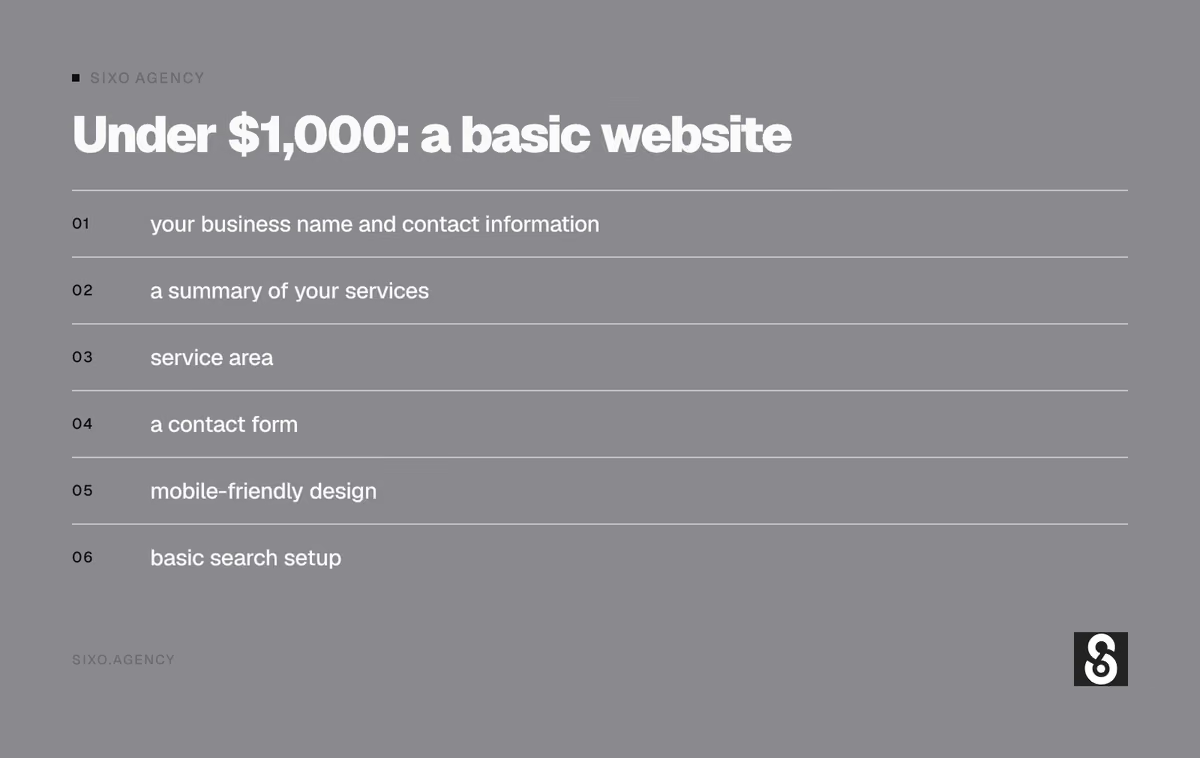
Under $1,000: a basic website
At this price, you are usually looking at a simple one-page site or a very small website built around an existing system or repeatable design process.
That may be perfectly adequate if you need somewhere professional to send people who already know your business.
A basic site might include:
- your business name and contact information
- a summary of your services
- service area
- a contact form
- mobile-friendly design
- basic search setup
The tradeoff is usually depth.
If you offer six important services and want each of them to show up separately in Google, one page does not give you much room to work with.
A one-page website can be a website.
It is not necessarily a search strategy.
$1,500 to $3,000: a typical small-business website
This is where you start seeing multi-page websites intended to do more than establish that the company exists.
A typical build might include:
- a homepage
- about page
- contact page
- several service pages
- custom or semi-custom design
- mobile optimization
- forms
- basic local SEO
- analytics
- content migration
- launch support
For many smaller Grande Prairie service businesses, this can be enough if the site is planned properly.
The important part is not whether you get five pages or seven.
It is whether those pages match the things your customers actually search for.
A plumbing company with five unrelated services usually gets more value from five properly planned service pages than one enormous page called “What We Do.”
$3,000 to $7,500+: custom business websites
Once the project becomes more custom, the price normally moves with it.
That can mean original design, more substantial content work, deeper search research, custom layouts, a larger site architecture, advanced forms, integrations or a more involved development process.
You are also more likely to see time spent on things most visitors never notice directly:
- redirect planning
- schema markup
- Core Web Vitals
- analytics configuration
- conversion tracking
- technical SEO
- accessibility
- structured service architecture
- content planning
- staging and testing
This is often where two quotes that both say “custom website” stop being remotely comparable.
One may mean someone changes the colours and photos in an existing theme.
The other may mean the entire site is planned around your business before a page is designed.
Those are different scopes.
$7,500 to $15,000+: larger or more complex websites
There is no hard ceiling.
A larger website can easily move into five figures when it needs:
- dozens of pages
- advanced e-commerce
- custom quoting systems
- customer portals
- booking systems
- third-party integrations
- large content migrations
- custom databases
- inventory feeds
- CRM integrations
- multilingual content
- complicated user permissions
At that point, you are not really paying for “a website.”
You are paying for a business system that happens to run in a browser.
Why can one website cost $999 and another cost $8,000?
Because page count is only one part of the work.
Imagine two companies both need a five-page website.
The first company already has its logo, photography, written content and a clear idea of what every page should contain.
The second needs someone to research competitors, determine which services deserve their own pages, write the content, organize photography, rebuild its search structure and move an existing website without losing valuable URLs.
Both may end up with five pages.
They did not require the same project.
Here are the things that usually move the price most.
1. How many pages does the website actually need?
More pages generally mean more planning, writing, design and development.
But the goal should never be adding pages just to make the website bigger.
Every useful page needs a reason to exist.
For a local service business, that might mean separate pages for services people actually search for.
A Grande Prairie contractor might need individual pages for several distinct services. A consultant with one focused offering may not.
The correct number is the number needed to explain the business properly and support the searches worth being found for.
Not five because five came in the package.
2. Is the design custom?
“Custom website” is one of those phrases that can mean almost anything.
At one end, a designer starts with an existing template and changes the colours, images and content.
At the other, the page structure, visual system and interactions are developed specifically for the business.
Neither approach is automatically wrong.
Templates can make sense when budget and speed matter more than having something unique.
Custom design starts making more sense when your brand, sales process or competitive market needs a site that does not look like the same theme wearing different clothes.
The important thing is knowing which one you are being quoted for.
3. Who writes the website?
This is easy to underestimate.
Someone has to decide what the site says.
Sometimes the business supplies every word.
Sometimes the designer takes existing material and cleans it up.
Sometimes research, keyword mapping, interviews and complete copywriting are part of the project.
Those are very different amounts of work.
And the words matter.
A beautiful service page saying almost nothing useful is still a weak service page.
Customers need to understand what you do.
Search engines do too.
4. Is SEO actually part of the build?
“SEO included” can mean anything from filling in a title tag to planning the entire site around search demand.
Ask what it means.
A website built with search in mind should consider things like:
- which services deserve dedicated pages
- what customers actually search
- page titles and headings
- internal links
- location relevance
- crawlable navigation
- page speed
- structured data
- image handling
- redirects from an old website
- mobile performance
SEO is much easier to build into the structure than repair after the site is finished.
That is why we treat SEO web design as part of planning the build, not a plugin installed at the end.
[Internal link: SEO web design]
5. Are you replacing an existing website?
A redesign can require more care than a brand-new site.
If your existing website already ranks in Google, has backlinks or contains pages people visit, simply deleting it and publishing a new structure can cause problems.
Every useful old URL needs to be accounted for.
Some pages stay.
Some move.
Some combine.
Some need permanent redirects.
That work is not visually exciting, but it can be the difference between launching a better website and accidentally erasing years of search history.
If you already have a site, the first question should not be:
“What should the new homepage look like?”
It should be:
“What is already working that we cannot afford to break?”
[Internal link: Website redesign]
6. Does the site need custom functionality?
A brochure website and a website that runs part of the business are different projects.
Cost rises when the website needs to do things such as:
- accept bookings
- calculate quotes
- process payments
- connect to a CRM
- display inventory
- create user accounts
- pull information from another system
- automate follow-up
- handle custom forms or workflows
This is where web design starts crossing into website development.
The distinction matters because a page can be designed in an afternoon while the functionality behind it takes days or weeks to build and test.
[Internal link: Website development]
7. Is it an online store?
E-commerce introduces another layer of work.
Products need to be organized. Payments have to work. Taxes and shipping need configuration. Product pages need structure. The checkout has to work properly on a phone.
Then there are questions such as:
- Shopify or WooCommerce?
- local pickup?
- shipping rates?
- product variations?
- inventory?
- discount codes?
- abandoned carts?
- payment processing?
- integrations?
A ten-page informational website and a store with 300 products are not comparable projects even if they both have a homepage and contact page.
8. Who supplies the photography?
Good photography changes a website.
It also changes the budget.
You can use supplied photos, stock photography, or commission original photography of the business, team, equipment and work.
For a local business, original photography is often one of the easiest ways to stop looking generic.
People can tell when the picture of the “Grande Prairie technician” was actually bought from a stock library and appears on seventeen other websites.
9. What happens after the site launches?
The build is one cost.
Keeping the website healthy is another.
Depending on the platform and provider, ongoing costs may include:
- hosting
- backups
- software updates
- security
- domain renewal
- maintenance
- content edits
- SEO
- analytics
- technical support
Ask about those before signing anything.
A cheap website with a mandatory long-term monthly contract can eventually cost more than a larger upfront build you own outright.
The opposite can also be true: a monthly plan can make sense when maintenance and support are genuinely included.
The number that matters is not just the launch price.
It is the cost of owning the website.
What should a Grande Prairie business actually spend?
Enough to solve the problem you have.
No more.
If you have no website and most of your work comes from referrals, a simple site may be all you need right now.
If you are trying to rank for several competitive services across Grande Prairie and the Peace Country, the site probably needs more depth.
If you are an established company losing leads because the current website is slow, confusing or almost invisible in Google, saving money by rebuilding the same problem does not accomplish much.
And if the website already works well?
Keep it.
We would rather tell someone their existing site is fine than manufacture a redesign because they asked for a quote.
That is what the audit is for.
[Internal link: Free website audit]
Cheap websites are not automatically bad
There is a temptation in this industry to say that anything inexpensive must be terrible.
That is nonsense.
A good designer with a narrow process can build a simple website efficiently.
Modern tools also make some parts of development much faster than they were ten years ago.
The better question is whether the limitations of the cheaper option match what you need.
If a $900 one-page site gives a new business exactly the online presence it needs, spending $8,000 does not make it more responsible.
But if you need fifteen service pages, custom photography, search research, an online booking flow and a CRM integration, expecting all of it for $900 means something has to disappear from the scope.
Usually several things.
Expensive websites are not automatically good either
Price is not proof.
Neither is a complicated proposal.
A $12,000 website can still be slow.
It can still have vague copy.
It can still launch without redirects.
It can still look beautiful and never rank for anything that matters.
Ask to see actual work.
Use the sites on a phone.
Search for the businesses.
Look at whether the pages explain real services or just fill space.
Read the reviews.
Then ask who is actually doing the work.
Those answers tell you more than the size of the quote.
What should be included in a website quote?
Before you compare prices, make sure each company is quoting the same thing.
At minimum, the proposal should make it clear:
How many pages are included?
And whether additional pages have a set cost.
Who provides the content?
If you are expected to write it yourself, know that before the project starts.
Is the design custom or template-based?
Neither answer is inherently bad. Ambiguity is.
What SEO work is included?
“SEO-ready” is not a scope of work.
Ask what will actually be done.
Who owns the website?
You should know who owns the domain, content, website files and accounts when the project ends.
Is hosting included?
If so, for how long and at what ongoing price?
What happens when you request changes?
Are revisions included? How many? What does ongoing support cost?
Is analytics installed?
You should be able to tell whether the new website is producing anything.
What happens to the old URLs?
If this is a redesign, redirect planning should be discussed before launch.
What is the actual final price?
A proper proposal should make the scope and number clear enough that you know what you are committing to.
Do you need to pay monthly for a website?
Not necessarily.
There are three common models.
One-time build
You pay for the project, then separately pay for hosting and any maintenance you want.
Monthly website plan
The upfront cost is lower, but the website is bundled into a recurring payment.
Build plus care plan
You pay for the website itself and optionally keep the designer involved for hosting, maintenance, backups and updates.
None is universally better.
Just find out what happens if you leave.
Can you take the website somewhere else?
Do you own the domain?
Do you retain the content?
Does the site stop working if you cancel?
Those questions matter more than whether the invoice arrives once or every month.
How much does Sixo charge for a website?
We quote websites based on the work rather than forcing every business into the same package.
A five-page site with supplied content is not the same project as a five-page site that needs search research, copywriting, custom photography, integrations and a migration from an existing domain.
So we start with the site you have, the market you are in and what you need the new one to do.
Then you get the scope, price and timeline before anything starts.
One number.
No mystery hourly total at the end.
If the audit shows that your current website is already doing its job, we will tell you that too.
How long does a website take to build?
For most Sixo projects, expect roughly four to six weeks.
The largest variable is usually content and feedback.
A straightforward site where everything is ready can move faster. A large build involving copywriting, photography, e-commerce, custom functionality or extensive migration work can take longer.
The important part is having the timeline agreed on before the project begins.
Is a new website worth the money?
Only if it fixes something that matters.
A new website can be worth the investment when the current one:
- cannot be found for important searches
- performs badly on mobile
- loads slowly
- does not explain your services clearly
- looks noticeably weaker than the companies you compete with
- loses leads through poor forms or navigation
- no longer represents the business
- cannot support the functionality you now need
The website itself is not the return.
The business it helps you win is.
That is the number worth paying attention to.
Start with the website you already have
If you already have a site, you do not need to decide whether to spend $1,000, $5,000 or $10,000 before somebody has even looked at it.
Start there.
We will look at what is working, what is not, who is ranking above you and whether rebuilding the site would actually solve the problem.
If the answer is yes, you will get a clear plan and a fixed quote.
If the answer is no, you will hear that instead.
Sixo Agency — Website design in Grande Prairie, Alberta.
[Get a free website audit]
[See our web design work]

Free digital audit
Get found locally.
We'll run a free, no-strings audit of your website and Google Business Profile — and show you exactly what to fix first to win more local customers.