
How Your Website Supports Your Google Business Profile
Your website and Google Business Profile should work together. Learn how service pages, business information, reviews, and local SEO support visibility.
Your Google Business Profile might be the first thing someone sees when they search for your company.
They can find your phone number, read reviews, check your hours, get directions, and visit your website without ever scrolling through a traditional search result.
For a local business, that is valuable.
But there is a problem with treating Google Business Profile as your entire online presence.
Your profile can tell someone that you offer a service. Your website has the room to explain that service, demonstrate your experience, and give someone a reason to choose you.
The two should support each other.
If your Google Business Profile says one thing and your website says something completely different, you are making it harder for customers to understand the business.
And if your website barely explains what you do, your profile has less useful supporting information available from your official website.
That is why we treat the relationship between a business website and its Google Business Profile as part of local SEO.
Not two unrelated marketing tasks.
Learn about local SEO in Grande Prairie
Does Your Website Affect Your Google Business Profile?
Yes, although the relationship needs to be understood properly.
Google says local results are mainly based on three factors:
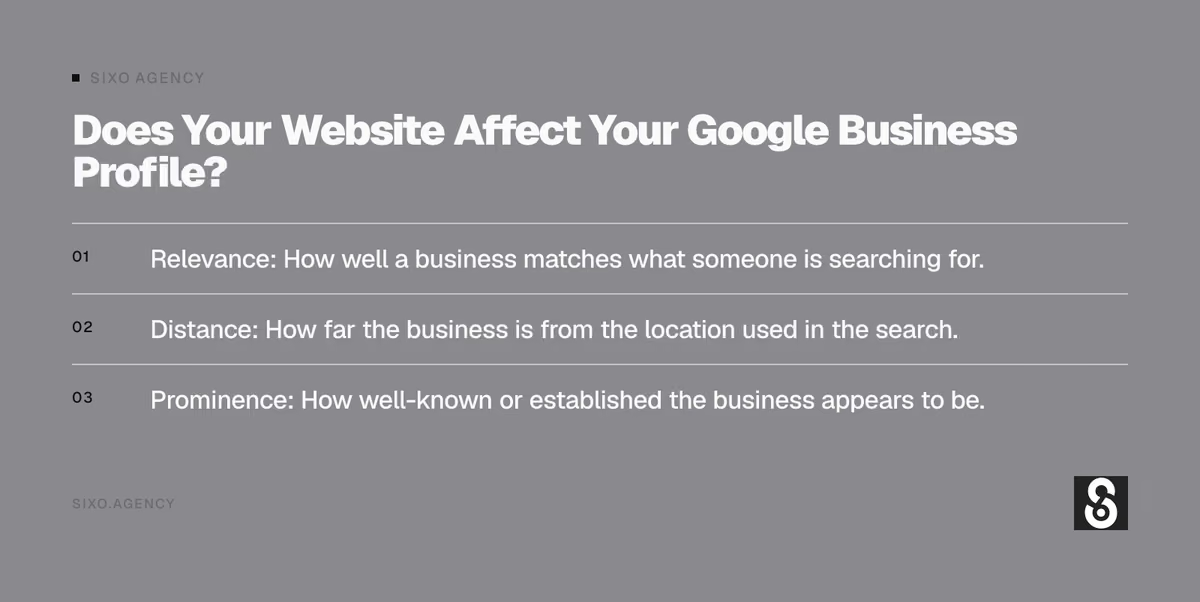
- Relevance: How well a business matches what someone is searching for.
- Distance: How far the business is from the location used in the search.
- Prominence: How well-known or established the business appears to be.
Your website cannot change your physical location.
It cannot guarantee that your business will appear in the local pack.
And simply adding keywords to your homepage will not automatically improve your Google Business Profile rankings.
But Google can use information from publicly available sources, including your official website, to understand business details.
That means your website has an important job.
It should clearly explain:
- Who the business is
- What services it provides
- Where it operates
- How customers can contact it
- What makes it credible
- How its services relate to one another
Your Google Business Profile provides a concise view of the business.
Your website provides the depth.
Your Website Should Confirm What Your Business Actually Does
Imagine a Grande Prairie contractor has a Google Business Profile describing the company as a concrete contractor.
The profile lists services such as:
- Concrete foundations
- Commercial flatwork
- Driveways
- Concrete repair
- Concrete pads
Now someone visits the website.
The homepage says:
Quality Construction Solutions for Every Project.
The Services page says:
Residential and Commercial Services.
There are a few stock photos and a contact form.
Nothing clearly explains concrete foundations, flatwork, driveways, or repairs.
The customer has to guess whether the business actually provides the service they need.
That is a website problem.
A stronger website would have a clear concrete-contractor homepage or service hub, supported by individual pages for important services.
Someone searching for concrete repair should be able to reach a page that actually discusses concrete repair.
The website and Business Profile would then describe the same real-world operation at different levels of detail.
This is one reason SEO web design starts with service architecture rather than choosing a layout and filling it with generic text afterward.
Explore SEO web design in Grande Prairie
Your Google Business Profile Should Link To A Useful Website
This sounds obvious.
It is surprisingly easy to get wrong.
The website link on a Google Business Profile should take visitors somewhere that helps them evaluate the business.
For a single-location company, that is often the homepage.
For a business with multiple genuine locations, the appropriate location page may be more useful.
The correct destination depends on how the business operates and what Google permits for the profile.
What matters is that the page represents the business accurately.
A customer should not click through and encounter:
- An outdated website
- A different business name
- A confusing service description
- A disconnected promotional landing page
- A broken contact form
- An unrelated location
- A website that barely works on a phone
The profile has already earned the click.
The website needs to do something useful with it.
Your Service Pages Provide The Detail A Business Profile Cannot
A Google Business Profile has limited space.
It can display categories, services, descriptions, photos, reviews, and other business details.
That is useful for quick evaluation.
But it is not a substitute for detailed service information.
Take a plumbing company offering hot water tank replacement.
The Business Profile might identify hot water tank installation as a service.
The website can explain:
- Signs a hot water tank needs replacing
- Different tank types
- Installation considerations
- What the service includes
- Whether emergency replacement is available
- What affects pricing
- Frequently asked questions
- How to request an estimate
That information helps a customer decide whether to contact the business.
It also gives search engines a clearer picture of what the website covers.
This is why we do not recommend cramming every service into a few sentences on one page.
Important services often deserve their own pages.
We covered the broader architecture in What Pages Does a Local Business Website Actually Need?.
Business Information Should Be Consistent
Your website and Google Business Profile should describe the same business.
That includes basic details such as:
- Business name
- Phone number
- Address, when publicly appropriate
- Website address
- Business hours
- Services
- Operating locations
Consistency does not mean copying identical text everywhere.
It means avoiding contradictions.
For example, imagine a company moves to a new building in Grande Prairie.
The Google Business Profile is updated.
But the website footer still shows the previous address.
The Contact page lists another phone number.
An old location page remains indexed.
Customers now have to figure out which information is correct.
The practical fix is straightforward: maintain accurate information across the places you control.
What If Your Business Operates From Home?
Not every business should publish a street address.
Google has specific rules for service-area businesses, including when an address should be hidden from customers.
If you operate from home and travel to customers, follow the applicable Business Profile guidelines.
Your website can still explain your genuine service area without exposing an address that should remain private.
Accuracy matters more than forcing every business into the same contact-page template.
Your Website Should Make Your Service Area Clear
Grande Prairie businesses often serve customers outside the city.
Depending on the company, that might include Clairmont, Sexsmith, Wembley, Beaverlodge, or other parts of the Peace Country.
The website should explain where the business actually works.
But there is a difference between describing a service area and generating dozens of nearly identical pages.
A contractor does not automatically need separate pages for every town within driving distance.
Sometimes a clear service-area section is enough.
A dedicated location page becomes more useful when there is meaningful information specific to that location.
That might include:
- Completed projects
- Local customer examples
- A real branch or office
- Distinct services
- Relevant operating information
- Location-specific questions
If every location page says the same thing with a different town name, the website is not adding much value.
And listing a town on your website does not make your business physically closer to someone searching there.
Google’s distance factor still matters.
Reviews Help Customers Evaluate The Business
Reviews are one of the most visible parts of a Google Business Profile.
Someone comparing three local companies may read reviews before visiting any of their websites.
That creates an opportunity.
Your website can reinforce the reputation customers see on Google.
For example, a restoration company might include:
- Relevant customer testimonials
- Detailed project examples
- Before-and-after photography
- Explanations of its process
- Information about the team
- Links to its public review profile
Those elements give visitors more context.
A short Google review saying a company handled a difficult project well becomes more meaningful when the website also demonstrates how that type of work is performed.
Should You Copy Google Reviews Onto Your Website?
You can display genuine customer feedback in appropriate ways, subject to permissions and platform requirements.
But do not assume that placing Google reviews on your website makes you eligible for review stars in Google’s organic search results.
Google has restrictions around self-serving review markup for LocalBusiness and Organization entities.
A review widget is not a shortcut to rich results.
Use reviews primarily because they help people make decisions.
Your Project Pages Can Demonstrate Real Local Experience
This is one of the strongest opportunities for local businesses.
A generic homepage can claim almost anything.
A completed project is harder to fake convincingly and much more useful to a prospective customer.
Imagine two Grande Prairie roofing companies.
The first website says:
Professional Roofing Services You Can Trust.
The second shows:
Commercial Roof Replacement — Grande Prairie
The project page explains:
- The type of building
- The problem being solved
- The materials used
- The scope of work
- Any relevant challenges
- Photos of the completed project
Which website gives you more confidence?
The project page also gives the company a natural opportunity to explain its services and local experience.
It does not need to repeat the city name twenty times.
The actual work supplies the context.
That is how local authority should be built: through evidence rather than slogans.
The Website Should Make Contacting You Easier
A Google Business Profile may generate calls directly.
Some customers will never visit the website.
Others will click through because they need more information before contacting the company.
When they arrive, the website should make the next step obvious.
For most local service businesses, that means:
- A visible phone number
- A clear contact page
- A straightforward quote request
- Service information
- Location or service-area details
- Hours or availability where relevant
- Mobile-friendly buttons and forms
Do not make someone search through five pages to find out how to hire you.
If a customer has already found your Business Profile and chosen to visit your website, the website should help finish the job.
See how Sixo approaches web design
Mobile Performance Matters After The Click
Picture someone sitting in a parking lot searching for an automotive repair shop.
They find a promising Google Business Profile.
The reviews look good.
They click the website.
Then they wait.
A large video loads.
A popup covers the page.
The menu is difficult to use.
The phone number is buried in the footer.
The customer goes back to Google.
That is not necessarily a local ranking problem.
It is a conversion problem.
The website lost a visitor who was already interested.
This is why we pay attention to mobile usability and performance when building websites for Grande Prairie businesses.
A website should load efficiently, explain the business quickly, and make the next action easy.
There is no prize for having the most elaborate animation in the search results.
Your Website Can Help Connect The Business’s Online Identity
Search engines encounter information about businesses in many places.
Your website is one of the few properties where you have substantial control over how the business is described.
It can provide a stable source of information about:
- The business name
- Services
- Location
- Contact details
- Team
- History
- Projects
- Other official profiles
Appropriate structured data can also describe the organization or local business in a machine-readable format.
For example, LocalBusiness structured data may be used to describe relevant business details.
That does not mean adding schema guarantees better Google Maps rankings.
It does not.
Structured data helps describe information.
It does not manufacture a reputation or replace accurate Business Profile information.
The underlying website still needs to be clear and useful.
The Website And Google Business Profile Should Support The Same Customer Journey
Think about what happens when somebody searches for a local service.
They might discover your business through the local pack.
They look at the reviews.
They inspect photos.
They check whether you provide the service.
Then they visit the website.
The website should continue the conversation rather than start over.
If the customer searched for commercial concrete work, they should be able to find commercial concrete information.
If they are comparing restoration companies, they should find relevant projects and service details.
If they need an appointment, the booking process should be obvious.
The transition should feel natural.
This is where website planning and local SEO strategy belong together.
The goal is not simply to appear in search.
It is to help the right customer become a real lead.
Track What Happens After Someone Clicks Through
If you are investing in a website and Google Business Profile, you should have some idea of whether they generate business.
Useful measurements may include:
- Website visits from your Business Profile
- Calls and other profile interactions reported by Google
- Website form submissions
- Quote requests
- Appointment bookings
- Important landing pages
- Organic search traffic
- Leads that turn into customers
Tracking will never be perfect.
Some people discover a company on Google, visit the website later, and call from another device.
Others call directly from the Business Profile.
You should not expect every lead to follow a perfectly measurable path.
But you can still learn a great deal.
For example, if your Business Profile sends visitors to the website but almost nobody submits a form, investigate the website experience.
If the website generates good leads but the Business Profile receives little attention, investigate the profile and broader local search visibility.
Different symptoms point to different problems.
Do Not Rebuild Your Website Just To Improve Your Google Business Profile
This is an expensive mistake.
A business notices that its local rankings are weak.
Someone recommends a new website.
The company spends thousands of dollars on a redesign.
The rankings barely move.
Why?
Because the website may not have been the primary problem.
Perhaps the Business Profile has incorrect categories.
Perhaps the business is competing against more prominent companies.
Perhaps the searcher is physically much closer to another provider.
Perhaps reviews, links, or other local signals need attention.
Or perhaps the existing website is already doing its job.
A new design cannot solve every one of those issues.
Before replacing a website, determine what is actually holding the business back.
That is why our website audit starts with evaluating the existing site rather than assuming every problem requires a rebuild.
Common Mistakes That Disconnect Your Website From Your Business Profile
A few problems come up repeatedly.
The Business Profile lists services the website never explains. Customers have to guess whether the business can help.
The website has outdated contact information. People encounter conflicting details.
Every service links back to the homepage. Visitors cannot easily find information about the specific work they need.
The business creates dozens of cloned town pages. The website grows without becoming more useful.
The website is difficult to use on a phone. Interested visitors leave before contacting the company.
The Business Profile links to an irrelevant page. The customer journey breaks between Google and the website.
The business focuses entirely on rankings. Nobody checks whether the traffic becomes calls or quote requests.
A redesign removes important service pages. Existing organic visibility can be lost because the migration was not planned.
These are not problems that require clever SEO tricks.
They require a coherent website and local search strategy.
What Should You Fix First?
If your website and Google Business Profile are not working well together, start with the fundamentals.
| Area | What To Check | Why It Matters |
|---|---|---|
| Google Business Profile | Business name, categories, services, hours, phone, and website link | Helps customers find accurate business information |
| Homepage | Clear business description, location, and primary services | Establishes what the company does |
| Service pages | Useful information about each important service | Helps visitors evaluate specific services |
| Contact page | Accurate contact details and easy-to-use forms | Reduces friction for potential customers |
| Service area | Genuine operating locations and relevant details | Makes geographic coverage clear |
| Mobile experience | Loading, navigation, buttons, and forms | Helps mobile visitors contact the business |
| Reviews and projects | Genuine feedback and completed work | Provides evidence of experience |
| Tracking | Profile interactions, website leads, and conversions | Helps identify what is working |
Check The Business Profile
Make sure the profile accurately represents the real business.
Review the business name, primary category, additional categories, contact details, hours, services, and website link.
Follow Google’s eligibility and representation guidelines.
Check The Website
Open the website on your phone.
Can you immediately tell what the business does?
Can you find the important services?
Is the service area clear?
Can you contact the company without hunting for a form or phone number?
Check The Service Pages
Does each important service have enough useful information to help a customer?
Or is everything squeezed onto one generic page?
Check The Proof
Can visitors see genuine work, reviews, projects, or other evidence of experience?
Check The Connection
Does the website linked from the Business Profile represent the same company, services, and location?
Check The Results
Look at profile interactions, website visits, and actual leads.
Try to identify where the process is breaking down before deciding what to rebuild.
When To Contact Sixo Agency
If your Google Business Profile is bringing people to a website that does not explain your services or generate leads, the website may need attention.
If your website is already doing its job but your business struggles to appear in local searches, the problem may be elsewhere.
Sixo Agency works with Grande Prairie businesses on web design, SEO-focused website architecture, Google Business Profile visibility, and local SEO.
We look at how those pieces connect before recommending what to change.
Quick Summary
Your Google Business Profile helps people discover and evaluate your business in Google’s local search experience.
Your website provides the space to explain services, demonstrate experience, answer questions, and turn interested visitors into customers.
The two work better when they share accurate business information, clearly describe the same services, and support a straightforward customer journey.
A website cannot control every local ranking factor. But a well-structured, useful website can support local search visibility and help convert the visitors your Business Profile sends.
FAQs About Websites And Google Business Profiles
Does My Website Affect My Google Business Profile Ranking?
Your website can provide information that helps Google understand your business, but it does not control local rankings by itself. Google says local results are mainly based on relevance, distance, and prominence.
Do I Need A Website If I Have A Google Business Profile?
A website is not required for every eligible Business Profile, but it gives you more control over how you explain services, show completed work, answer questions, and generate leads.
Should My Google Business Profile Link To My Homepage?
For many single-location businesses, the homepage is an appropriate destination. Businesses with multiple genuine locations may benefit from linking to an appropriate location page, depending on their setup and Google’s guidelines.
Should Every Service Have Its Own Website Page?
Not necessarily. Important services often benefit from dedicated pages when there is enough useful information to justify them. Closely related or minor services may fit naturally on a broader page.
Do I Need A Separate Page For Every Town I Serve?
No. Create location pages when they provide genuine, location-specific value. Repeating the same content with different town names is not a useful long-term strategy.
Does Adding LocalBusiness Schema Improve Google Maps Rankings?
Structured data helps describe business information to search engines, but adding LocalBusiness schema does not guarantee better Google Maps rankings.
Can A Better Website Help Generate More Leads From Google Business Profile?
Yes. A clear, fast, mobile-friendly website with useful service pages and straightforward contact options can help turn interested visitors into enquiries.
Can Sixo Agency Help With Both Web Design And Local SEO?
Yes. Sixo Agency provides web design, SEO-focused website architecture, and local SEO services for businesses in Grande Prairie and the Peace Country.

Free digital audit
Get found locally.
We'll run a free, no-strings audit of your website and Google Business Profile — and show you exactly what to fix first to win more local customers.