
How Website Design Affects Local SEO
Your website can help or hurt local search visibility. Learn how site structure, service pages, speed, mobile design and content affect local SEO.
A website can look fantastic and still be almost invisible in local search.
That happens more often than it should.
The site launches with sharp photography, smooth animation and a homepage everyone likes. Then somebody searches for one of the company’s actual services in Grande Prairie and the business is nowhere to be found.
The problem is not necessarily that somebody forgot to “do SEO.”
Often, the problem started much earlier.
It started when the website was planned.
If important services were combined onto one thin page, the navigation hides useful content, the site is painful on a phone or an old website was replaced without preserving valuable URLs, there may be no simple SEO switch to flip afterward.
That is why website design and local SEO should not be treated as completely separate jobs.
Your website does not control every local ranking factor.
It does, however, give search engines a substantial amount of information about who you are, what you do and where you do it.
Those decisions begin before the website is built.
Does web design actually affect local SEO?
Yes, but probably not in the way people mean when they ask the question.
Google says local results are primarily determined by three broad factors:
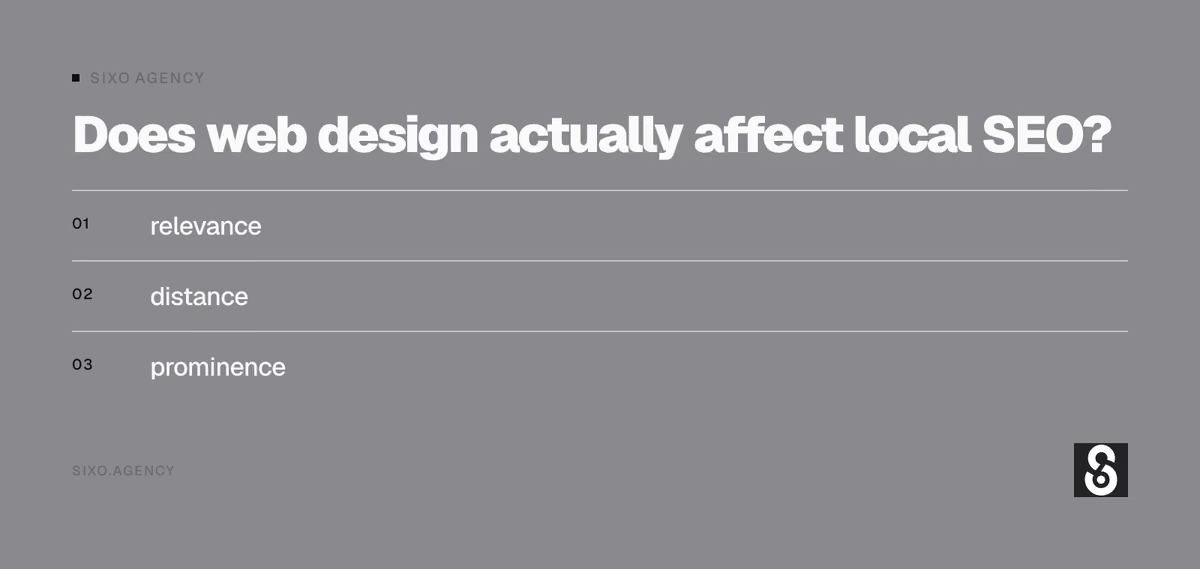
- relevance
- distance
- prominence
Your website cannot change where your business is physically located relative to the person searching.
It cannot manufacture a good reputation.
It cannot replace a properly maintained Google Business Profile.
But the website can help establish what your business does, where it operates and how its services relate to the searches people make.
It can also make your content easier or harder for search engines to discover and understand.
So web design affects local SEO through things such as:
- site architecture
- service pages
- internal linking
- content organization
- crawlability
- mobile usability
- page performance
- location information
- redirects
- structured data
- the relationship between your website and Google Business Profile
Some of those decisions are technical.
Most are structural.
And structural mistakes are much easier to prevent during a build than repair afterward.
1. Your website architecture tells Google what the business actually does
Suppose a Grande Prairie contractor offers:
- commercial concrete
- foundations
- flatwork
- excavation
- grading
- snow removal
Now imagine the entire website consists of:
Home
About
Services
Contact
And the Services page gives each service two sentences.
Technically, all of the services are on the website.
That does not mean the website explains any of them particularly well.
Now compare that with a structure containing:
Services
- Commercial Concrete
- Foundations
- Concrete Flatwork
- Excavation
- Grading
- Snow Removal
Each important service now has somewhere to be explained properly.
The business can show relevant projects, answer questions, describe the work and connect related information without forcing everything onto one enormous page.
That is not keyword stuffing.
It is information architecture.
And it is one of the reasons we decide what pages a local business website actually needs before getting too far into the visual design.
2. Important services usually deserve more than a paragraph
One of the most common local-business website problems is the catch-all Services page.
You have probably seen it.
Our Services
Plumbing
We provide complete plumbing solutions.
Heating
Our experienced team handles all your heating needs.
Drain Cleaning
Contact us for professional drain cleaning.
Hot Water Tanks
We install and repair hot water tanks.
Everything the company does technically appears on the website.
Almost nothing useful has been said.
A dedicated service page gives the business room to answer questions a customer actually has.
For example:
- What problems do you solve?
- Who is the service for?
- What does the work involve?
- What options are available?
- What does it cost?
- How long does it take?
- What areas do you serve?
- What related services might be required?
- What work have you completed before?
- How does someone get started?
The page becomes useful because there is enough room to be useful.
This is a central part of how we approach SEO web design.
Search structure is decided while the site is being planned rather than bolted onto a finished design.
3. The homepage cannot rank for everything
Small businesses often expect far too much from their homepage.
Imagine a company wants to be found for:
- plumber Grande Prairie
- drain cleaning Grande Prairie
- hot water tank replacement Grande Prairie
- boiler repair Grande Prairie
- furnace repair Grande Prairie
- commercial plumbing Grande Prairie
Then every one of those services points back to the homepage.
That creates a problem.
What is the homepage actually about?
The homepage should establish the broader business.
The individual service pages can establish the individual services.
Think of it as a hierarchy.
The homepage says:
We are a plumbing and heating company serving Grande Prairie.
The drain-cleaning page says:
Here is everything you need to know about our drain-cleaning service.
The boiler page does the same for boilers.
The commercial page explains the commercial side of the business.
Now the site has depth instead of one page trying to be relevant to everything.
4. Navigation affects what visitors and search engines can find
Navigation is a design decision.
It is also an information decision.
If an important service is buried somewhere nobody can reasonably discover it, the website has an architecture problem.
That does not mean every page needs to appear in the main menu.
A large website would become unusable.
It means there should be logical paths between related information.
For example:
Home → Services → Furnace Repair
Then Furnace Repair might connect to:
Furnace Installation
Heating Maintenance
Relevant Projects
Financing
Contact
The visitor can move through the subject naturally.
The website starts behaving like a connected body of information rather than a collection of isolated URLs.
5. Internal links help establish those relationships
Internal links are links between pages on your own website.
They are simple.
They are also routinely neglected.
Imagine we publish an article called:
How Long Does a Furnace Last in Alberta?
Halfway through the article, we explain the signs that a furnace is approaching replacement.
That is an obvious place to link to the company’s furnace-replacement service.
Not because we need another keyword link.
Because that is where the reader may logically need the service.
The reverse relationship can also work.
The furnace-replacement page could link to supporting information about:
- furnace lifespan
- repair versus replacement
- efficiency
- maintenance
- available systems
That creates a group of related pages around a real subject.
This article is doing the same thing.
If you want the deeper explanation of how search considerations are built into the website itself, see our SEO web design service.
The link exists because the subjects genuinely connect.
That is what internal linking should feel like.
6. Mobile design matters because local searches often have immediate intent
Local search frequently happens when somebody needs something.
A furnace stopped.
A windshield cracked.
A pipe is leaking.
A customer needs a restaurant.
Someone is looking for a contractor.
The person may be searching from a phone, and they may not have much patience.
Now imagine they reach a website where:
- the text is tiny
- the menu is difficult to use
- a popup covers the screen
- the phone number cannot be tapped
- the quote form has fourteen fields
- the page shifts around while loading
- they cannot figure out whether the company serves their area
They may never discover how good the company is.
They leave.
Good mobile design is not shrinking the desktop site until it fits.
It means asking what someone on a phone actually needs to accomplish.
For many local businesses that means making it extremely easy to:
Call.
Request a quote.
Find the location.
Check hours.
Understand the service.
See proof.
A local-business website should be designed around those actions.
7. Website speed is part of the experience
A fast website is better than a slow website.
That statement should not be controversial.
But page speed sometimes gets turned into an SEO superstition where businesses chase a perfect score while ignoring everything else.
That misses the point.
Performance matters because people are waiting for the page.
Heavy images, unnecessary scripts, third-party widgets, excessive animation, poorly configured fonts and bloated plugins can all make the experience worse.
And local businesses should pay particular attention to mobile performance.
Your customer may not be sitting at a desk connected to fibre.
They might be in a truck.
On a jobsite.
In a parking lot.
Outside Grande Prairie on a weaker connection.
We would rather have a fast, clear website that immediately explains the business than an elaborate loading animation asking somebody to admire our creativity while they wait.
Our website audit looks at real mobile performance alongside structure, indexing, redirects and the other technical foundations that can affect how a site performs.
8. Core Web Vitals are useful, but they are not your entire SEO strategy
Core Web Vitals measure aspects of the experience people have while a page loads and responds.

They are useful diagnostics.
They are not the business strategy.
A website can perform beautifully in a speed test and still have:
- no useful service pages
- weak content
- poor internal linking
- no local relevance
- confusing navigation
- no proof
- no authority
Likewise, improving a genuinely slow website can make the site considerably better without suddenly moving a business from nowhere to number one.
Performance belongs inside the larger system.
Do not ignore it.
Do not worship it either.
9. Your headings should organize information, not decorate it
Headings are often treated as visual elements.
Make this text big.
Make that one smaller.
But headings also describe the organization of a page.
A good page might look conceptually like:
Furnace Repair in Grande Prairie
Signs your furnace needs repair
Furnace problems we diagnose
What happens during a service call
Repair or replace?
Areas we serve
Furnace repair FAQs
That hierarchy makes sense even without seeing the design.
Now compare it with:
Welcome
Quality You Can Trust

Our Difference
Solutions
Excellence
Contact Us Today
It may look perfectly polished.
It communicates very little.
Design should make useful content easier to understand.
Not replace it with slogans.
10. Location information should be clear without becoming spammy
A Grande Prairie business should make it easy to determine that it serves Grande Prairie.
That does not require writing “Grande Prairie, Alberta” in every second sentence.
Useful location information can appear naturally through:
- the homepage
- contact information
- service pages
- About content
- project examples
- service-area information
- testimonials
- location pages where justified
- structured business information
The objective is clarity.
A visitor should not need to investigate whether the company works where they live.
Neither should a search engine.
11. Location pages only work when there is a reason for them to exist
This deserves repeating because local SEO has produced a lot of terrible websites.
Suppose a business serves:
- Grande Prairie
- Clairmont
- Sexsmith
- Wembley
- Beaverlodge
It is tempting to create five pages, copy the same text onto each and swap the town name.
That creates more URLs.
It does not necessarily create more value.
A useful location page should contain information relevant to that market.
That could include:
- work completed there
- specific services available there
- customer examples
- local photos
- neighbourhoods or surrounding areas
- response or travel information
- location-specific questions
- genuine differences in service
If the only unique information on the page is the town name, reconsider whether the page needs to exist.
Local relevance should come from the actual business.
Not a find-and-replace command.
12. Your website and Google Business Profile should tell the same story
Your website and Google Business Profile are different properties.
They should still describe the same business.
Google says Business Profile information can come from several sources, including publicly available web content such as the business’s official website.
That makes consistency useful.
If your website says you specialize in three services but your profile barely mentions them, there is a disconnect.
If your profile points to a website that never explains the service somebody searched for, that is not particularly convincing either.
The website should clearly establish:
- the business
- important services
- location
- contact information
- service area where appropriate
The Business Profile should accurately reflect the same real-world operation.
This relationship is where local SEO and web design begin to overlap.
13. The website supports local SEO, but it is not the whole job
This distinction matters.
You cannot redesign a website and expect every local ranking problem to disappear.
Google says local rankings are mainly based on relevance, distance and prominence.
Other parts of the local search system can include:
- Google Business Profile information
- business categories
- reviews
- links
- mentions
- business information across the web
- physical proximity to the searcher
Some of those things happen entirely outside your website.
If the site is already excellent but the Google Business Profile has been ignored for three years, rebuilding the homepage may not be the best use of money.
That is exactly why we prefer to look first.
Sometimes the website is the problem.
Sometimes local SEO is the problem.
Sometimes the Google Business Profile needs the attention.
Sometimes all three need to work together.
14. Structured data helps describe the business
Structured data is information added to the code of a page in a format search engines can process.

Visitors generally never see it.
For a local business, structured data can help explicitly describe information such as the organization or local business behind the website.
Depending on the site, structured data may also be appropriate for things such as:
- breadcrumbs
- organizations
- local businesses
- products
- events
- other supported content types
It is useful.
It is also frequently oversold.
Adding LocalBusiness schema does not turn a weak website into a strong local search result.
It helps machines interpret information that should already be clear from the website itself.
Think of structured data as labels on organized boxes.
Putting excellent labels on a pile of empty boxes does not give you more inventory.
15. A redesign can hurt existing visibility if migration is ignored
This is one of the easiest ways for design and SEO to collide.
A company has an older website.
It is ugly.
Everyone agrees it needs replacing.
The new site launches and looks substantially better.
There is just one problem.
The URLs changed.
Old service pages disappeared.
Content was removed.
Pages with links pointing to them now return errors.
Redirects were never mapped.
A redesign should improve the website without casually throwing away whatever search value the old site already earned.
Before replacing an established website, identify:
- existing URLs
- pages receiving organic traffic
- pages with external links
- pages currently ranking
- content worth preserving
- URLs that will change
- redirects required
Then build the migration into the project.
This is why our website redesign process treats URL mapping and redirects as part of the rebuild rather than something to remember after launch.
16. Better design can improve what happens after the search
Ranking is only half the problem.
Suppose your business reaches the top of a search result.
Someone clicks.
Then the website looks questionable, loads poorly and makes the visitor hunt for the phone number.
Congratulations.
You won the ranking and lost the customer.
The purpose of local SEO is not rankings.
It is business.
Design matters after the click because people are evaluating:
Does this company do what I need?
Do they work here?
Do I trust them?
Have they done this before?
What will this cost?
How do I contact them?
A good website answers those questions with as little friction as possible.
That is where SEO and conversion design meet.
Traffic that never becomes a lead is not much of a victory.
17. Real proof makes local pages stronger
Local businesses have an advantage national websites often do not.
They have actual work happening in an actual market.
Use it.
A contractor can show completed projects.
A restoration company can document losses it restored.
An automotive shop can show the facility, technicians and vehicles.
A web designer can show websites built for recognizable local businesses.
Useful proof might include:
- project photos
- case studies
- customer reviews
- before-and-after examples
- team photography
- equipment
- locations
- completed work
That material does more than make a website look local.
It makes the website more useful to someone trying to decide whether the business is credible.
There is a huge difference between saying:
Trusted by Grande Prairie businesses.
and showing the Grande Prairie businesses that trusted you.
18. Website design affects whether content can grow later
A website should not be designed only for the pages it has on launch day.
It should have somewhere sensible to put the next useful piece of information.
Maybe customers keep asking:
How much does this cost?
That could become a cost guide.
Maybe they constantly compare two options.
That could become a comparison article.
Maybe you complete a particularly good project.
That could become a case study.
Maybe one service has grown enough to deserve several supporting resources.
The site architecture should be able to accommodate that.
That is how authority grows over time.
For example, our guide to how much a website costs in Grande Prairie supports the commercial web-design pages without forcing a long pricing discussion onto the main service page.
The content has a job.
And it has somewhere logical to live.
What web design mistakes can hurt local SEO?
If you are planning a new website or redesign, these are the mistakes I would watch most closely:
- putting every service on one thin Services page
- designing the sitemap before researching what the business actually offers
- hiding important pages deep in the site
- building pages visitors cannot easily reach through internal links
- creating dozens of nearly identical location pages
- replacing useful URLs without redirects
- removing content that already ranks without checking it first
- making the mobile experience an afterthought
- loading pages with unnecessary scripts and effects
- using headings entirely for visual styling
- making location and service-area information difficult to find
- publishing generic copy that could belong to any competitor
- treating SEO as something that begins after launch
Most of those are easier to prevent than repair.
Should you design the website for Google?
No.
Design it for the customer.
But understand how the customer finds it.
Those are not conflicting goals.
A customer benefits from:
- clear navigation
- useful service pages
- fast loading
- readable content
- accurate location information
- logical internal links
- helpful answers
- real proof
Search engines also benefit from a website whose information is clearly organized and accessible.
The best local-business websites rarely feel “SEO’d.”
They feel obvious.
You immediately understand what the company does, where it works and where to go next.
That clarity is the goal.
Local SEO should start before the website is designed
If search matters to the business, do not wait until the site is finished to think about it.
Before the design begins, determine:
What services actually matter?
Which deserve their own pages?
What does the current website already rank for?
Which URLs need to survive a redesign?
Where does the company actually work?
What questions are customers asking?
What proof exists?
How should those subjects connect?
Then design the website around the answers.
That is much easier than approving a beautiful 12-page website and asking six months later why Google does not understand half of what the company does.
Start with the site you already have
You may not need a new website.
That is worth saying.
If the site is structurally sound, performs well and already has the right pages, the better investment may be content, your Google Business Profile, reviews or broader local SEO work.
If the website itself is holding the business back, then rebuilding it makes sense.
The only useful way to know is to look at what is actually happening.
Our free website audit looks at the site’s structure, mobile experience, performance and technical foundations alongside what is happening in search.
If the website is fine, we will tell you.
If it needs work, you will know why.
And if you are building from scratch, start with SEO web design so the search structure exists before the visual design gets locked in.
Sixo Agency — Web design and local SEO in Grande Prairie, Alberta.

Free digital audit
Get found locally.
We'll run a free, no-strings audit of your website and Google Business Profile — and show you exactly what to fix first to win more local customers.